Collective Fitness

There is a well-known African proverb which states, “It takes a village to raise a child”, but I believe this proverb can be extended to a community’s health and fitness too. The longer I lead exercise classes with the people in my community, the more I have come to  believe in village dynamics; because it truly takes a village to raise a community’s collective health and well-being.

I’ve thought much about the ‘active community’ within the small, rural town in which I work and live; of those whom I instruct in Zumba and personal training and balance and strength groups, they have become my family. They are indiviually and collectively my  tribe. They are my happy place; my cherished people. When our regular times to move together are disrupted, my happiness quotient is diminished until we re-engage. And it seems this sentiment is felt by most all those who identify themselves with any given  active tribe.

It occurs to me, that being a part of an active tribe is an especially essential component to the well-being of the ‘over the hill’ gang. Mature bodies require a great deal of extrinsic motivation to stay physically active and engaged. But the truth of the matter is people of every age and stage need, depend, and crave an active ‘village’ to stay on track with health and fitness goals. And when one participates within their active village, the collective energy and enthusiasm provides a collective power to keep its members happily moving together, physically and socially.

As a fitness instructor, I benefit from these group dynamics just as much as those who attend my exercise classes. I notice that we all depend on and look forward to our group movement with great expectations; our times together revitalize and energize all who participate…in body, mind, and spirit.

Ailing bodies don’t keep us sick. Our attitudes and perspectives do.  Karen Casey

I should not be surprised by this phenomenon, but I am, and I want to write about this so as to encourage my readers to never neglect the importance and value of their ‘village’ people. It makes no matter, the size of your tribe, when two or more gather for purposeful movement, lives are impacted and well-being is extended into the community. We all need an active tribe of which we may call our own. Happy, healthy lives are not created in solitary, isolated pursuit, but rather in ‘tribal’ collectives of like minded individuals.

If you belong to an active community of exercising people whom you consider your ‘tribe’ then you no doubt have reaped the benefits of your collective. If you want to raise the well-being of your village, seek out those community members who need a ‘tribe’ to join. Pass the baton of well-being on to those within your community; it’s no harder than inviting a neighbor or friend to take a walk-about your village. Every step together builds your village strong and healthy!


Just Practice

As  a personal trainer I often admonish my clients to put their mind into their muscles when they engage in strength training activities. It is my fervent belief that we train our muscles best when we practice putting our mind on feeling what our muscles are doing throughout each exercise repetition.

The energy of the mind is the essence of life. Aristotle

When it comes to strength, muscles or otherwise, I believe our mind is our most potent, powerful agent and ally for change in our physical body and in our life. What we think  (believe) has the potential to germinate the seeds of well-being or dis-ease. With every thought, with every belief, we grow ourselves stronger, larger. It’s just that simple.  If you want to get better at anything, then your betterment is determinant upon your practice of doing.

Your brain reflects the way that you think throughout your life. You kind of shape it by your thoughts and your behaviors. If you play violin for eight hours a day, then the parts of the brain responsible for helping you to play the violin will get larger. If you’re thinking stressful thoughts for the whole day then those parts of the brain are going to get larger and other parts of the brain will deteriorate. Jo Marchant

Your brain is like a muscle that responds (grows) by the thoughts you put into it from your mind. Your mind is superior to your brain. Your mind (your soul, your personality, your will) feeds and directs your physical brain. Conscious and subconscious thoughts  bathe your brain with input (thought for food…food for thought) 24/7. Check your thought diet! Are you consciously or unconsciously feeding your brain junk food? Junk thoughts?

If you think you are in danger, your brain sets into motion your fight or flight response. Your breathing respirations increase as does your blood pressure; all systems are on high alert, ready for action. Conversely, if you think you are in safety, your parasympathetic pathways are engaged, and your body is calmed, your breathing is slower and deeper and your blood pressure returns to normal. Your brain needs your mind to direct its resources in accordance to your body’s needs. Your mind drives your body. Have you checked whose in charge lately?

The mind is willing, but the body is weak.

Whatever virtue, trait or ability you want to improve or enlarge in your life, you must only do one thing: PRACTICE, PRACTICE, PRACTICE. This is so simple. This is why I am often fond of saying, “less is more”. It only takes one thought, one act of your will, to put into motion a healthier, happier life. You decide. So please do not be careless about what you think because it will effect what you practice.


Fit for Life…Everyday Exercise 10 of 10

REVERSE DELTOID FLY! This is the tenth and last exercise in the functional fitness series. The reverse deltoid (shoulder) fly exercise targets the muscles on the posterior of the shoulders together with the muscles of the upper back. When this exercise is performed in a standing (bent over) position, the abdominal core, spine, glutes and lower back are also engaged.  A modified (seated) version of this exercise is also illustrated for those individuals who have lower back pain or weakness.

HOW TO: This exercise should  be initiated without hand weights first so as to develop the feel and posture of proper exercise form.

  • Stand with your legs about hip-width apart, arms at sides. Bend your torso forward and bend your legs slightly so that your arms extend below your body with your hands facing each other. This is the starting position.
  • IMPORTANT: First check your posture via a mirror before beginning the exercise; make sure your upper back is flat (not rounded); squeezing your shoulder blades together will help flatten your back.
  • Now, make a fist with each hand, knuckles pointing toward the floor, then, raise your arms out to your sides, while squeezing your shoulder blades together during the movement, maintain a slight bend in your elbows at the end of your upward arc, and do not raise head/chin upward.
  • Next, lower your arms (slowly) to the starting position. This completes one repetition. Perform eight to 12 repetitions (without dumbbells).
  • Once you can perform 1 to 2 sets of 8 to 12 repetitions while maintaining good exercise form, its time to add some light dumbbell weights to your workout. Start with dumbbells that weigh less than or equal to 5 pounds each.
  • Using the dumbbells, perform 8 to 12 repetitions. That is 1 set. Perform up to 3 sets.


8cfd5332633bc652_reverse-fly-reallly_xxxlarge (2)

Bent Over Reverse Deltoid Fly


MODIFICATION: Seated Reverse Deltoid Fly

seated-rear-deltoid-fly

Seated Reverse Deltoid Fly

Sit on the edge of a armless chair or bench with legs together, torso bent over legs, upper back flat (not rounded) and arms hanging alongside the outside of your legs. Then follow the ‘How To’ steps above to perform the seated version of this exercise.

This post concludes the functional fitness exercise series. I hope you have found this information helpful in guiding you towards a better understanding of your body’s capabilities in regards to ‘functional fitness’.

If you are able to practice these 10 exercises (as often as you can manage or tolerate) it may only be a matter of weeks (or a few months) before you notice increases in your functional strength and movement patterns.

I hope that whatever improvements you realize from these exercises will be enough to encourage and motivate you to KEEP UP THE GOOD WORK!  Listen to your body, honor it with gentle, disciplined, functional exercise movements and it will serve you well for many days to come.
CHEERS & HIGH FIVE!


Fit for Life…Everyday Exercise 9 of 10

WOOD CHOPS! This is the ninth of ten exercises in the functional fitness series. This exercise mainly targets the abdominal core (front, side, back) but it also requires shoulders and hips to engage and stabilize the body during the rotational movement phase. The wood chop can be performed with a dumbbell, medicine ball, cable pulley, or resistance band. This exercise has many progressions and variations and is suitable for most every fitness level.

HOW TO: Perform this exercise without a weight in your hand; practice moving through the entire range of motion un-weighted.

High to Low Wood Chop

  • Start with you feet wider than shoulder width apart, toes point slightly outward.
  • Clasp both hands together (or hold weight) elbows extended (but not locked), above and to the right side of head/body.
  • Rotate arms and torso downward towards left side of body.
    • Towards hip if standing
    • Towards knee if squatting
  • Return to start
  • Perform 8 to 12 repetitions
  • Switch sides; repeat exercise
modmedballwoodchop

Wood Chop standing

7d07848a13bf0a0b_medball-woodchop_preview

Wood Chop squatting


Low to High Wood Chop

  • Start with you feet wider than shoulder width apart, toes point slightly outward.
  • Clasp both hands together (or hold weight) elbows extended (but not locked), to the right side of body.
    • Towards hip if standing
    • Towards knee if squatting
  • Rotate arms and torso upward towards left side of body.
  • Return to start
  • Perform 8 to 12 repetitions
  • Switch sides; repeat exercise
low to high woodchop

Low to High Wood Chop


Remember: Use no weight or something which weighs less than or equal to 5 lbs. when you first begin practicing this exercise. Because of the rotational aspect of the wood chop exercise, perfecting your form first will help prevent muscle strain in your lower/upper back.


Fit for Life…Everyday Exercise 8 of 10

SINGLE LEG SHOULDER PRESS! This is the eighth of ten exercises in the functional fitness series. This exercise targets the shoulder muscles while enhancing core stability and simultaneously challenging your balance.

HOW TO: Stand on your left leg. Hold a dumbbell in your right hand, palms facing forward and keep your core tight and spine neutral as you raise it straight above your head. Slowly lower your right arm down so that your right elbow and forearm form a 90-degree angle (pictured below). shoulder pressRepeat the movement for 8 to 12 reps and then perform the shoulder press while holding the dumbbell in your left hand. Now balance on your right foot, holding the dumbbell in your right hand, press up for 8 to 12 repetitions; then repeat holding the dumbbell in your left hand for the same about of repetitions.
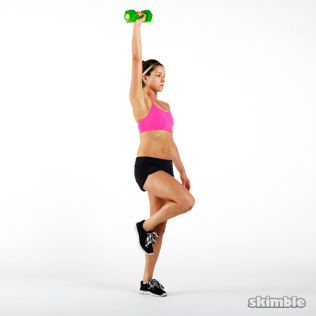
dumbbell-single-leg-shoulder-press-

Note: Choose and use a dumbbell weight which you can press up at least 8 times with one arm.

HOW TO PROGRESS: 1. Hold dumbbells in both hands, balanced on one leg, press both arms above shoulders for 8 to 12 repetitions. Switch to balance on your other leg, repeat repetitions.
2. Hold dumbbells in both hands, balanced on one let, alternatively press one arm at a time above shoulders for 8 to 12 repetitions. Switch to balance on your other leg, repeat repetitions.


Fit for Life…Everyday Exercise 7 of 10

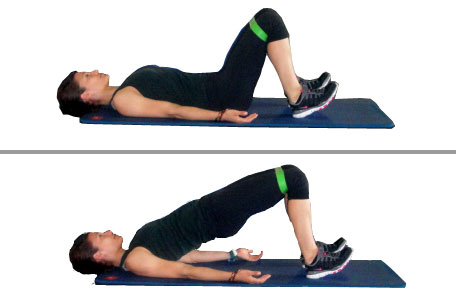
HIP BRIDGES! This is the seventh exercise of ten in the functional fitness series. This move targets the glutes and the core (abdominals and spine) and promotes hip flexibility and strength in the hamstrings and hip adductors.

HOW TO PERFORM:

  • Lie on your back.
  • Place your feet flat on the floor, hip-width apart, toes pointing forward, with your knees bent.
  • Contract your abs and your glutes.
  • Exhale and lift your hips off the floor until your body is a straight line from your knees to your shoulders.
  • Hold this position for a two count and lower hips back to the floor.
  • You may perform the bridge as a continuous movement, or hold the pose for extended periods of five seconds or more.
  • Remember to keep breathing normally if you hold the pose for an extended period.
hip bridge

Basic Hip Bridge

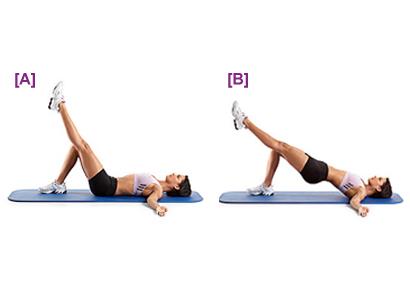
HOW TO PROGRESS: There are several variations that will challenge and activate additional muscle groups in your legs, hips and lower back. Progress to any of the following only after you can perform 1 – 2 sets of 8 to  12 repetitions of the basic hip bridge without hamstring cramping or lower back strain.

  • Single leg hip bridge. After you lift your hips off the floor, extend one leg into the air. Or start this hip lift with one leg on the floor and one leg extended. You may perform this pose as a continuous movement for a count of two, or hold the pose for five seconds or more.
single leg hip bridge

Single leg hip bridge

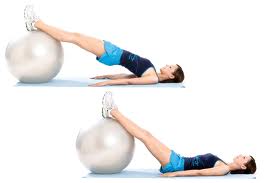
  • Perform a basic hip bridge with your feet above floor level (on a chair or bench) or on an unstable surface like a stability ball.


glute bridge on ball

Hip Bridge on Ball

Functional exercise number 8 of 10 will be posted by December 9th.


Fit for Life…Everyday Exercise 6 of 10

SINGLE LEG DEAD LIFTS! This is the sixth exercise of ten in the functional fitness series, and it is the first exercise of the series which provides balance, strength, mobility and stability training all at once for the lower body. Specifically, dead lifts will target the hamstrings, glutes and lower back muscles, while engaging joints at the ankle, knee and hip.

HOW TO PERFORM:

  • Assume a single-leg stance
  • Keep the back straight and the torso tight. Look straight ahead, retract shoulder blades.
  • Prepare for movement by balancing 100% on supporting leg then,
  • Lower the upper body by bending at the hip. Keep the back straight and supporting knee soft (with a slight bend).
  • Swing the free leg back so it stays in line with the torso.
  • Simultaneously move your arms forward (away from your body) to counter balance.
  • Lower the upper body until a mild stretch is felt in the hamstrings.
  • Return to the starting position.
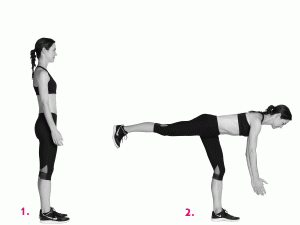
  • Perform as many repetitions as you can (5 – 12) while maintaining good form (see picture 2 below).
  • Repeat on other leg.
single leg dead lift

Single leg dead lift


In the beginning, you may need to modify (reduce) your range of movement for this exercise. If you cannot balance with your swing leg fully extended behind you, then hinge only to the point where you can maintain your balance before returning to the starting position. If you’ll practice a few repetitions every day, your balance and stability will improve in short order.

TO PROGRESS: Once you are able to perform a full set of 10 – 12 repetitions in good form, you may increase your posterior strength chain by holding dumbbells (3 to 8 pounds) or a weighted bar in your hands while performing this exercise. Start with lighter weights and maintain proper form while  performing 8 to 12 repetitions on each leg.

Single-Leg-Deadlift-Kettlebell

Single leg deadlift with dumbbells

Functional exercise number 7 of 10 will be posted by December 4th.


Fit for Life…Everyday Exercise 5 of 10

JUMPING JACKS! This is the fifth exercise of ten in the functional fitness series, and it is the first exercise in the group so far which provides an opportunity to train the cardio-respiratory system while also challenging your functional balance and coordination. The shoulders, core, hips, legs and ankles are all activated during a jumping jack maneuver.

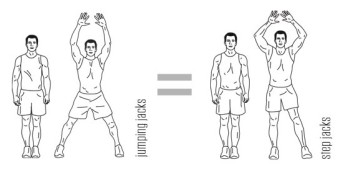
This old-fashioned, body weight exercise is considered a high impact maneuver when executed in its traditional form. The hops made out to the side may create too much impact stress for individuals with joint pain or instability in their knees, hips, or ankles. Shoulder joints will also be used to a full range of motion (overhead), so again, moderate your moves if you have known weakness or pain in these areas. A modified jumping jack (described below) may be performed and will give you similar fitness benefits while keeping your joints happy.

HOW TO PERFORM:

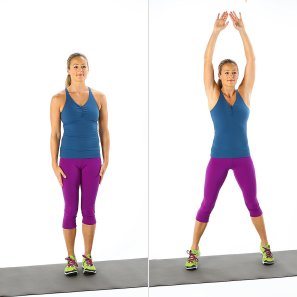
  • Stand with your feet together and your hands down by your side.
  • Engage your stomach muscles, then
  • In one motion jump your feet out to the side and raise your arms above your head.
  • Immediately reverse that motion by jumping back to the starting position.
  • Perform as many repetitions as you can (10-100) while maintaining good form.
Jumping-Jacks

Jumping Jack


MODIFIED SIDE JACKS: 

  • Stand with your feet together and your hands down by your side.
  • Engage your stomach muscles, then
  • In one motion move one foot out to the side and raise your arms above your head.
  • Immediately reverse that motion by returning your arms and leg to the starting position.
  • In the next motion, move the other foot out to the side and raise your arms above your head.
  • Perform as many repetitions as you can (10-100) while maintaining good form.

jumping jack modified

TO PROGRESS: Once you are able to perform 2 to 5 sets of  10 repetitions of jumping jacks, you may want to add small jump rope type hops and / or skipping moves to the jumping portion of your functional fitness routine. All of these exercises will help increase your leg strength, stamina, balance and coordination. Functional fitness exercise 6 of 10 will be posted before the Thanksgiving holiday. Cheers!


Fit for Life…Everyday Exercise 4 of 10

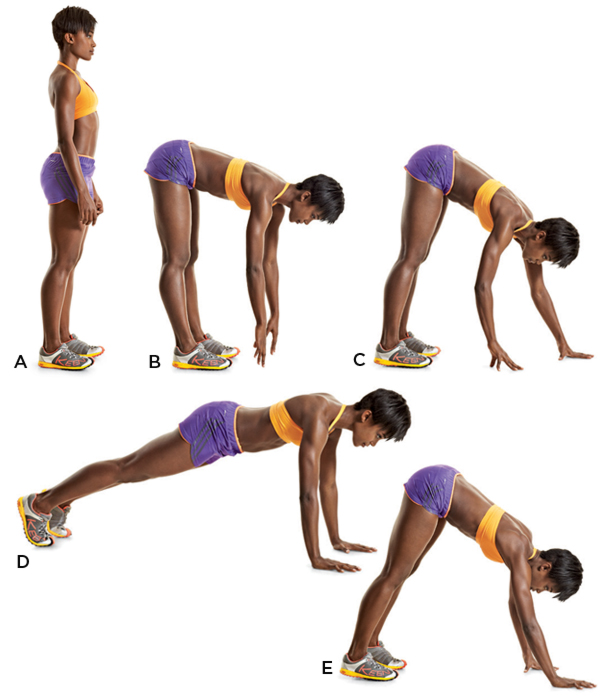
WALKOUTS! This is the fourth exercise of ten in the functional fitness series and as such it is a true body weight exercise. The walkout will use every major joint in the body when executed to completion. It is for this reason that it has a prominent place in the top ten daily exercises.

The Walkout

How To Perform: Before engaging in the actual walkout exercise you may want to perform some lower body exercises to warm up your legs and back before beginning the walkout. Once you are warmed up, perform a few toe touch repetitions (step B) to realize a nice stretch in your legs and back.

If you are still working on upper body strength and not sure whether you can perform the entire exercise with good form, then only perform steps A through C of the walkout for the first week or two before walking yourself out (and back) to the high plank position. You may bend your knees during the beginning of the walkout phase to assist your hands reaching the floor without over-stretching your hamstrings.

Perform three to ten walkouts each day, paying special attention to your form throughout the exercise. When you reach the end of the walkout (step D), make sure your shoulder and wrists are aligned (one above the other), and engage your core (no sagging or hiking at the hips) so your body forms a straight line from shoulders to toes. Hold this position for a count of three to five seconds, then walk yourself back to a standing position. Perform up to 10 repetitions.

Little by little one walks far. ~ Peruvian Proverb

How To Progress: As you gain upper body strength and core stamina, you can progress this exercise by adding some pushups at step D,  before walking yourself back to the standing position. Additionally, you may challenge your core strength by walking your hands out a couple inches past your shoulders and a little wider than shoulder width apart (pictured below). Hold this new position for three to five seconds in good form, then walk your hands back toward your feet to the standing position.

The Walkout Progressed

The Walkout Progressed

Perform these purposeful exercises faithfully everyday, and your strength and flexibility will improve before your very eyes. Functional fitness exercise 5 of 10 will be posted within the next few days. Keep moving!


Fit for Life…Everyday Exercise 3 of 10

PLANKS! This is the third exercise of ten in the functional fitness series and is probably one of the best exercises for building core strength. The purpose of my writing about these ten exercises is to post in a permanent place those movements which adults of most any fitness level can perform every single day so as to achieve or maintain their fitness which will support their activities of daily living.

Initially, the plank exercise may create a bit of a challenge for adults who find it difficult to get down onto the floor. If you cannot get down to the floor and safely back up again, it is wise to perform the first two functional exercises from this series, squats and pushups (wall and counter versions) until sufficient body strength is developed to get up and down from ground level.

The plank is an isometric (static, non-moving core exercisewhich also strengthens the shoulders, glutes and hamstrings. This exercise also has an important role in improving one’s posture and balance. The ‘low’ plank (pictured below) is performed by hovering one’s body above the floor, balanced only on forearms and toes, forming a straight line from shoulders to heels. In this position, the abdominals will be engaged (braced) together with the gluteal and thigh muscles while simultaneously continuing to breathe normally. Work up your first hold time to 30 seconds. Add another 1 or 2 sets of 30-second holds as you build up your strength.

plank1 (2)

How To Progress: As you improve your strength, you’ll want to progress and vary your planking routine. Progress from a forearm plank to a straight arm (high) plank. Once you can hold a high plank for 2 or 3 sets of 30-second holds, you can add side planks (pictured below) to your repertoire. Performing variations to the basic plank (front, side) will quickly enhance your core strength and stability and it will also improve and challenge the surrounding (secondary or synergistic and stabilizing) muscles throughout your back and shoulders.

side plank on knees

Functional fitness exercise number 4 of 10 will be posted mid-week.