Collective Fitness

There is a well-known African proverb which states, “It takes a village to raise a child”, but I believe this proverb can be extended to a community’s health and fitness too. The longer I lead exercise classes with the people in my community, the more I have come to  believe in village dynamics; because it truly takes a village to raise a community’s collective health and well-being.

I’ve thought much about the ‘active community’ within the small, rural town in which I work and live; of those whom I instruct in Zumba and personal training and balance and strength groups, they have become my family. They are indiviually and collectively my  tribe. They are my happy place; my cherished people. When our regular times to move together are disrupted, my happiness quotient is diminished until we re-engage. And it seems this sentiment is felt by most all those who identify themselves with any given  active tribe.

It occurs to me, that being a part of an active tribe is an especially essential component to the well-being of the ‘over the hill’ gang. Mature bodies require a great deal of extrinsic motivation to stay physically active and engaged. But the truth of the matter is people of every age and stage need, depend, and crave an active ‘village’ to stay on track with health and fitness goals. And when one participates within their active village, the collective energy and enthusiasm provides a collective power to keep its members happily moving together, physically and socially.

As a fitness instructor, I benefit from these group dynamics just as much as those who attend my exercise classes. I notice that we all depend on and look forward to our group movement with great expectations; our times together revitalize and energize all who participate…in body, mind, and spirit.

Ailing bodies don’t keep us sick. Our attitudes and perspectives do.  Karen Casey

I should not be surprised by this phenomenon, but I am, and I want to write about this so as to encourage my readers to never neglect the importance and value of their ‘village’ people. It makes no matter, the size of your tribe, when two or more gather for purposeful movement, lives are impacted and well-being is extended into the community. We all need an active tribe of which we may call our own. Happy, healthy lives are not created in solitary, isolated pursuit, but rather in ‘tribal’ collectives of like minded individuals.

If you belong to an active community of exercising people whom you consider your ‘tribe’ then you no doubt have reaped the benefits of your collective. If you want to raise the well-being of your village, seek out those community members who need a ‘tribe’ to join. Pass the baton of well-being on to those within your community; it’s no harder than inviting a neighbor or friend to take a walk-about your village. Every step together builds your village strong and healthy!


Consider the Sacred

How often do I consider my life and all its proclivities in regards to the sacred? I’m not even sure why I have an attachment to write about this topic today. All I know is that I have found a strand of thought that has captured my attention for the moment, and it seems fitting to follow the strand where ever it wants to lead me for now.

It should not surprise me that one thought leads to another; whether a thought originates in my own thinking or whether it has been introduced by some one else, it does not matter. That the thought sparkled and dazzled and asked to be admired by me is reason enough to give it consideration for this moment.

Why do I bother attending to a fleeting thought? Because I trust that some thoughts are worthy of introspection. And in this space of now, I trust that this thought, with its attending question and percolating intrigue, has captured my attention because I am ready to receive a lesson. I have lived long enough to realize that a piqued interest is usually indication of openness to instruction.

So perhaps my intrigue has whet your curiosity too, and if that is the case, then I invite you to join me for awhile in this quest to apprehend reason on this little bypass, as I consider: What does it mean when we say some ‘thing’ is sacred to us?

Now remember, how I mentioned earlier how one thought often leads to another, then another. Well this thought about sacred things, I believe, was brought to my consciousness because of something I read a few days ago. (Note to self & note to reader: Be careful what you read!)

Anyway, I believe the question which took form before my mind this morning was smoldering as a result of this statement in the “Love Your Body” chapter of A Course in Weight Loss by Marianne Williamson: The purpose you ascribe to something determines its effect on your life. I am not sure why these two ideas feel connected to me, but they do. And I am not sure why I feel like these ideas are important to share within the space of a health and well-being blog, but I do. So be patient with me, as I attempt to connect some dots and unravel this ball of twine of mine.

When I think quickly about this idea of the sacred, all of a sudden the “S” word lifts ‘things’ up to a level above my eyes. It, the object, whatever is beheld as sacred, becomes instantly special, reserved, set aside, honored, revered. Do we use this word so frequently and loosely today, that its meaning and power is lost on our modern sensibilities? Perhaps. But what do I hold as sacred? What or where is the repository for the sacred in my life? What then does it mean when I attribute sacredness to something or someone?

I think the connection is this: What I believe and hold as sacred in my life, I will treat with special honor and reverence. The sacred will receive my best attention, care and protection. In other words, if I purpose some ‘thing’ as sacred, then my actions will support and be a natural outcome of my intentions and my beliefs. The purpose you ascribe to something determines its effect on your life”.

As a married person (34+ years), I consider my relationship with my spouse as sacred. I am intimately bound up in his life and he in mine; we two have become and live as one. Our relationship is set-aside and unique from all our other relationships. I honor this sacred relationship and protect it by keeping my heart’s affections solely upon and for my husband.

As a spiritual being, I consider my relationship with the Divine One as sacred. Similar to my marriage, the Holy One and I co-exist in intimate, loving relationship. There is no way to separate Spirit from spirit. I honor my Spirit-life my spending time in worship and meditation. This relationship centers me and brings light and love to every area of my life.

As one who inhabits a physical body, I consider my relationship with my body as sacred. I am profoundly thankful for everything it does for me, this container which holds my soul. I honor my physical-life by making the time and taking efforts to exercise, nourish and rest my body in accordance to its needs.

As a personality who engages others within myriad roles and relationships (daughter, mother, wife, friend, etc.), I notice that my sacred intent takes less form here. I do not hold my relationships in such sacred esteem. And yet, I can see the merit in assigning them to a higher purpose in my life.  We all have been created and set in this world to live in relationship to one another. Perhaps the disconnect I feel in many of my relationships is a result of my not assigning a higher purpose and value to them? Yes, this is surely a strand of thought which I must further consider and evaluate!

Finally, I have come to the end of the trail. I have made a connection, faint though it be, it is thus: That which I hold as sacred, I protect and honor. If I feel or experience disconnect in my body, spirit or in my relationships, then I have likely ascribed to it a lessor purpose or value in my life. The purpose you ascribe to something determines its effect on your life.”

If I regard something as sacred or worthy, then I will act in ways which demonstrate my belief. That which I believe guides my intentions. My belief becomes my action. Those things which I focus my most care-full attentions and energies upon, also sheds light upon those things which I hold as sacred. What about you? What is sacred to you?


Fit for Life…Everyday Exercise 4 of 10

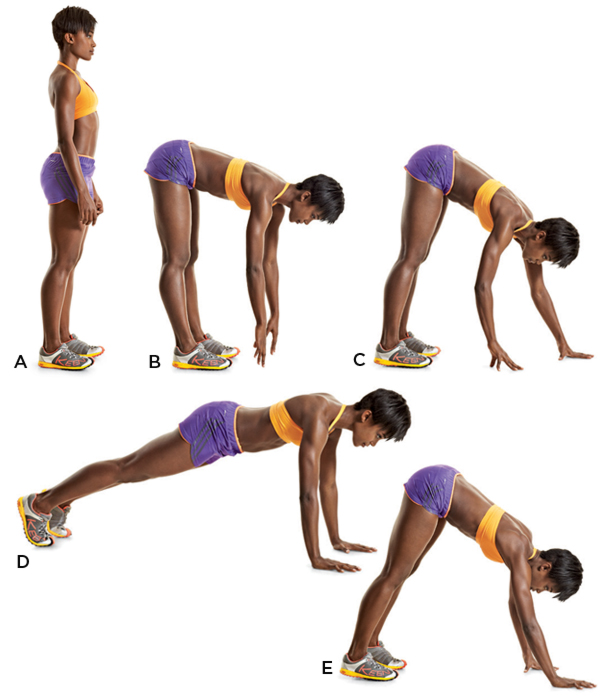
WALKOUTS! This is the fourth exercise of ten in the functional fitness series and as such it is a true body weight exercise. The walkout will use every major joint in the body when executed to completion. It is for this reason that it has a prominent place in the top ten daily exercises.

The Walkout

How To Perform: Before engaging in the actual walkout exercise you may want to perform some lower body exercises to warm up your legs and back before beginning the walkout. Once you are warmed up, perform a few toe touch repetitions (step B) to realize a nice stretch in your legs and back.

If you are still working on upper body strength and not sure whether you can perform the entire exercise with good form, then only perform steps A through C of the walkout for the first week or two before walking yourself out (and back) to the high plank position. You may bend your knees during the beginning of the walkout phase to assist your hands reaching the floor without over-stretching your hamstrings.

Perform three to ten walkouts each day, paying special attention to your form throughout the exercise. When you reach the end of the walkout (step D), make sure your shoulder and wrists are aligned (one above the other), and engage your core (no sagging or hiking at the hips) so your body forms a straight line from shoulders to toes. Hold this position for a count of three to five seconds, then walk yourself back to a standing position. Perform up to 10 repetitions.

Little by little one walks far. ~ Peruvian Proverb

How To Progress: As you gain upper body strength and core stamina, you can progress this exercise by adding some pushups at step D,  before walking yourself back to the standing position. Additionally, you may challenge your core strength by walking your hands out a couple inches past your shoulders and a little wider than shoulder width apart (pictured below). Hold this new position for three to five seconds in good form, then walk your hands back toward your feet to the standing position.

The Walkout Progressed

The Walkout Progressed

Perform these purposeful exercises faithfully everyday, and your strength and flexibility will improve before your very eyes. Functional fitness exercise 5 of 10 will be posted within the next few days. Keep moving!


Fit for Life…A Functional Exercise Plan (A Series of 10)

In recent years, ‘functional fitness’ has become a buzz word in the fitness industry to sell and package a wide array of exercise programs to potential training clients. Whether sports specific or generalized training is sold, functional fitness terminology is used so frequently that it often means different things to different populations.

For purposes of my Fit for Life Series, I define functional fitness (exercise) as a strength training plan which involves performing work against resistance (preferably body weight resistance) in such a manner that the improvements in strength directly enhance the performance of movements found in those activities of daily living. Yet, before I continue with a discussion of functional fitness, I would first like to define the dual components of fitness.

The health related  components of fitness measure an individual’s cardiorespiratory endurance, muscular strength and endurance, flexibility and body composition (% fat vs. lean tissue). The skill related components of fitness rate an individual’s agility, coordination, balance, power, reaction time and speed.

Used in this context, a functional, Fit for Life, exercise plan would train your body for life, rather than for a specific sport or for a certain aesthetic appearance. This type of training is especially helpful for older adults because it addresses muscle imbalances and asymmetries, and it addresses improvements (strength, flexibility) for the ways we move  throughout our daily activities.

There are five basic movement patterns that we use in everyday life:

1. Bend-and-lift movements. In the gym we call it squatting, in everyday life it’s getting in and out of a chair or squatting down to lift a bag of groceries from the floor. Bend and lift movements require strength in the glutes, quads, and hamstrings, but also plenty of stability in the core, and flexibility in the knees and ankles.

2. Single-leg movements. You’ll often train single leg movements in the gym with a variety of lunging movements. In real life, single-leg movements are called for when you walk, when you climb or descend stairs, or when you bend and reach forward on one leg to get something from the floor. Like the bend-and-lift movements, single-leg movements require combined strength, stability and flexibility with an added element of balance over a changing center of gravity.

3. Pushing movements. Pushing movements typically involve your upper body pushing forward (opening a store door) pushing overhead (putting an object on a high shelf) or pushing to the side (lifting your torso from a side-lying position). In your workout you can train for pushing movements with pushups, overhead presses or side planks.

4. Pulling movements. Pulling movements in your activities of daily living might include pulling the car door shut, pulling the sheets down from the top shelf of the linen closet, or pulling your suitcase off the floor. In your workouts you’ll train for pulling movements by developing core stability, strength in your back and shoulders, stability in your shoulder blades and flexibility in your shoulders.

5. Rotational movements. Your thoracic spine rotates with every step you take and any time you swing a golf club or tennis racket. Any time you reach across your body or twist through the spine, you’re engaging in a rotational movement. This complex movement pattern requires a great deal of core stability and strength to support the spine during the rotational motion.

Over the next few weeks, I will post ten articles. Each article will fully describe and illustrate the activities I believe are the best exercises to perform each day to improve fitness and function for life.

My next blog entry will describe the basic squat exercise with options for various progressions as improvements in strength are realized. I look forward to sharing my thoughts and these training tips with you, my blog reader in the days ahead; I invite your comments and questions should you desire to engage in a conversation on this topic.


Tell Me a Story…For Brain Power

No matter our age, most everyone likes to hear or read a good story. Whether we read the story to someone or narrate as storyteller, these activities are powerful medicine for our brains because these behaviors activate neural pathways which might otherwise not get mobilized. Some might argue that reading to ourselves is just as effective as reading out loud to others, however, silent reading is similar to watching television in terms of the amount of mental energy utilized by the brain.

So remember, if you want to sharpen your intellectual edge and build some brainy muscle, then gather together a friend or two and tell or read them a story. You never know, but your doing so could spark creative inertia  among your group of listeners; your story telling might just be the catalyst which inspires another person to write and tell a story. Perhaps their story is just waiting for a reason to be told.


Puzzle It…For Brain Power

Returning to the simple games of our childhood is yet another way we can enhance brain power as we progress in age through the decades. Improved language skills can be realized by doing crossword puzzles. Likewise, spatial awareness is advanced when you put together a jigsaw puzzle. If you already engage in puzzle activities, you can improve your mental powers by undertaking more challenging puzzles.

Not a puzzle person? Remember there is brain strengthening power for you when you engage in novel activities. So perhaps an easy word search or Sudoku puzzle will whet your appetite for further puzzling. If you enjoy using a computer, you can find word search and crossword puzzle applications for your computer or smart phone too. Don’t wait for a rainy day to have puzzle fun. Schedule regular puzzle breaks into your daily routine; think of puzzling as exercise for your brain. So be creative and puzzle it today to strengthen your most important muscle…for brain power!


Sharpen Your Senses…for Brain Power

You probably have to be around 50 years old or so (plus or minus a decade) before you actually begin to notice that some of your physical senses (sight, sound, taste, touch, smell) are not as keen as they used to be in the decades that have passed since your youth.

Whether the diminishing of our senses is from overuse, disuse or abuse, it really doesn’t matter; however, we do have some recourse when it comes to maintaining or improving our current sensory switchboard. If you have been reading the brainpower posts, then you already know that our brain is plastic, meaning, it is capable of learning new things, making new connections, and crisscrossing hemispheres to perform new or novel tasks. Yes, even in middle age, thank goodness, neural-plasticity is our friend, and we can help our brain stay healthy and dynamic when we perform old tasks in new ways.

So what follows are some ideas for you to use in the coming days. Perform these ‘exercises’ with some regularity to make your neural pathways strong and dependable.

For sight – Blinking frequently, palming, eye-tracking exercises

For hearing – turn the volume down and listen with intent; listen to different genres of music and try to  identify specific instruments being played

For taste – eating with the eyes closed and think about taste and texture; chew your food thoroughly to unlock more flavor molecules

For touch – Close eyes and attempt to sort coins by touch; give and receive body massage; with a friend, practice writing the letters of the alphabet using your finger as pencil on your friend’s arm, hand or back

For smell – every day smell deeply some specific item whether it be food, or flower, or fragrance; then use words to describe the scent. Performing these two activities regularly will help sprout new scent receptors.

Source


Keep Running…It May Save Your Life

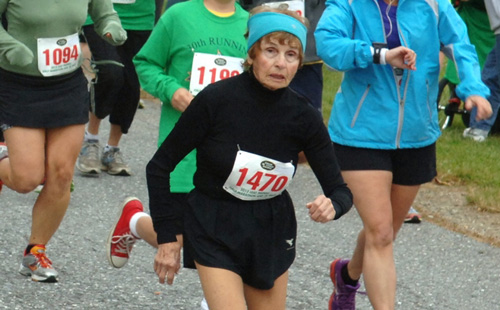
I love to run…anyone who knows me knows that, but what I love almost as much as running are stories about runners who inspire…inspire me to keep going as I run through the decades of my life. Yesterday’s post on Runner’s World was just such a story. A story that took over half a century to unfold, but those many years were needed to make a strong point about the power of running to heal our bodies and minds; when we put our shoes on and show up to run, no matter how we feel (mentally or physically) we set off a chain reaction of health and healing for ourselves. Whether we are 30 years old or 80+ years old, running is excellent therapy. Read Sylvia’s story and be inspired today and know with certainty that the obstacles to your  well-being can be overcome with the help of God and your own two legs.  Now get out there and have a wonder-filled run!


Spell Me a Sign…for Brain Power

As you may or may not know, novelty is a key component in creating healthy brain architecture. This is the third post in the brainpower series and in today’s mind enlarging message I would like to give you another activity that will challenge and grow your brain’s neural network, specifically your visual and motor skill centers. You can enhance and wake up your brain’s neural connections by learning this new skill: sign language.

I had the opportunity to learn sign language some years ago when I was raising my infant grandchild. I wanted to be able to communicate with my grandson and have him be able to communicate with me long before he could speak words and sentences. He was not hearing impaired, but learning and teaching him sign language gave us a way to communicate before he was verbal. It was fun (and a bit challenging) to teach an infant to mimic hand signs to communicate about things and ideas like: eat, more, all-done, dirty, apple, dog, cat, bird, banana, etc. But even before his first birthday, my grandson and I could express rudimentary needs and ideas by using sign language.

For adults, learning sign language is like learning a foreign language, and unless an we have strong intrinsic motivation, most of us tend to lose interest quickly in the novelty of acquiring a secondary language. But I would like to challenge you to approach learning sign language as a health and well-being activity. Practice making the simple letter signs of the alphabet with your hand and fingers; then coordinate these letters to sign your name. This activity is a powerful, two-fold brain trainer. Using your hands and eyes at the same time to sign letters and memorizing these symbols and the order in which to use them requires muscle (motor), visual and memory skills to be employed simultaneously. This effective training activity is like a tonic for our brains. Not only will learning this skill recharge sluggish neural connections but when practiced faithfully, you will also make brand new neural connections (muscle memory). And that’s how you build a strong brain!

So go ahead, spell me a sign! A chart of the sign language alphabet is pictured below…give it a try and show someone you know your newly acquired brainpower from the palm of your hand!

signlanguageabc02


Organize and Rearrange…for Brain Power

In the previous ‘Brain power‘ post, I discussed the value of mixing up our exercise and activity routines to help our neural network make new connections. Practicing non-dominant activities helps our brain build redundancy into our brain circuitry. Such behaviors may in fact help ward off or reduce the effects of aging and disease. In today’s post I would like to consider the refreshing brain benefits of organizing and re-arranging our living spaces.

Brain researchers have known for some time that organized people perform better on memory tests. Getting organized helps build better memory. The old adage ‘A place for everything and everything in its place’ is built on this organization principle. But organization skills do not have to be exorbitant to be helpful. Spending five minutes organizing one’s desk or medicine cabinet can improve efficiency, memory and possibly reduce stress levels too.

A related activity, re-arrangement, also helps our brains strengthen spatial and visual connections. For instance, by re-arranging furniture in your living spaces on an occasional basis, the brain must re-map neural connections to assist us in navigating the new floor space and layout. Something as simple as moving a trash can from one location to another, requires our brains to re-map circuitry (memory and movement) as we must now navigate to a new location to throw away a piece of litter. Taking a different route home (on foot or in our vehicle) provides a similar benefit.

It doesn’t require much, except may a little creativity on our part, to change the scenery in which we reside and navigate. Kitchen cabinets, pantries, desks, counters and backyard walkways all provide ample opportunities for us to challenge and improve our brain’s neural pathways.

Remember, brainpower increases and improves when we build novelty into our regular activity patterns. When we do familiar things in unfamiliar ways we wake up nerve cells which in turn increases blood flow to make these new connections for our brain cells. A little change goes a long way.